leastfixedpoint

Tony's Link Log

6 links tagged with “nuance”

96 links in 40 categories.

Atom 1.0 feed Atom feed for links tagged with nuance

Links added 17 September 2026

ChatGPT is bullshit.

Michael Townsen Hicks, James Humphries, Joe Slater (8 June 2024)
🔗 https://link.springer.com/article/10.1007/s10676-024-09775-5
#llm #bcs #nuance #paper #academia

In which it is argued that LLMs, as a category, are “bullshit machines”:

Bullshit. Any utterance produced where a speaker has indifference towards the truth of the utterance.

From the abstract:

[LLMs] have been plagued by persistent inaccuracies in their output; these are often called “AI hallucinations”. We argue that these falsehoods, and the overall activity of large language models, is better understood as bullshit in the sense explored by Frankfurt (On Bullshit, Princeton, 2005): the models are in an important way indifferent to the truth of their outputs.
Links added 25 August 2026

The Generative AI Learning Penalty: Evidence from Chinese Secondary Education.

David Strömberg, Victor Lei, Yanhui Wu (2 June 2026)
🔗 https://papers.ssrn.com/sol3/papers.cfm?abstract_id=6868618
#llm #nuance #paper #academia #bcs

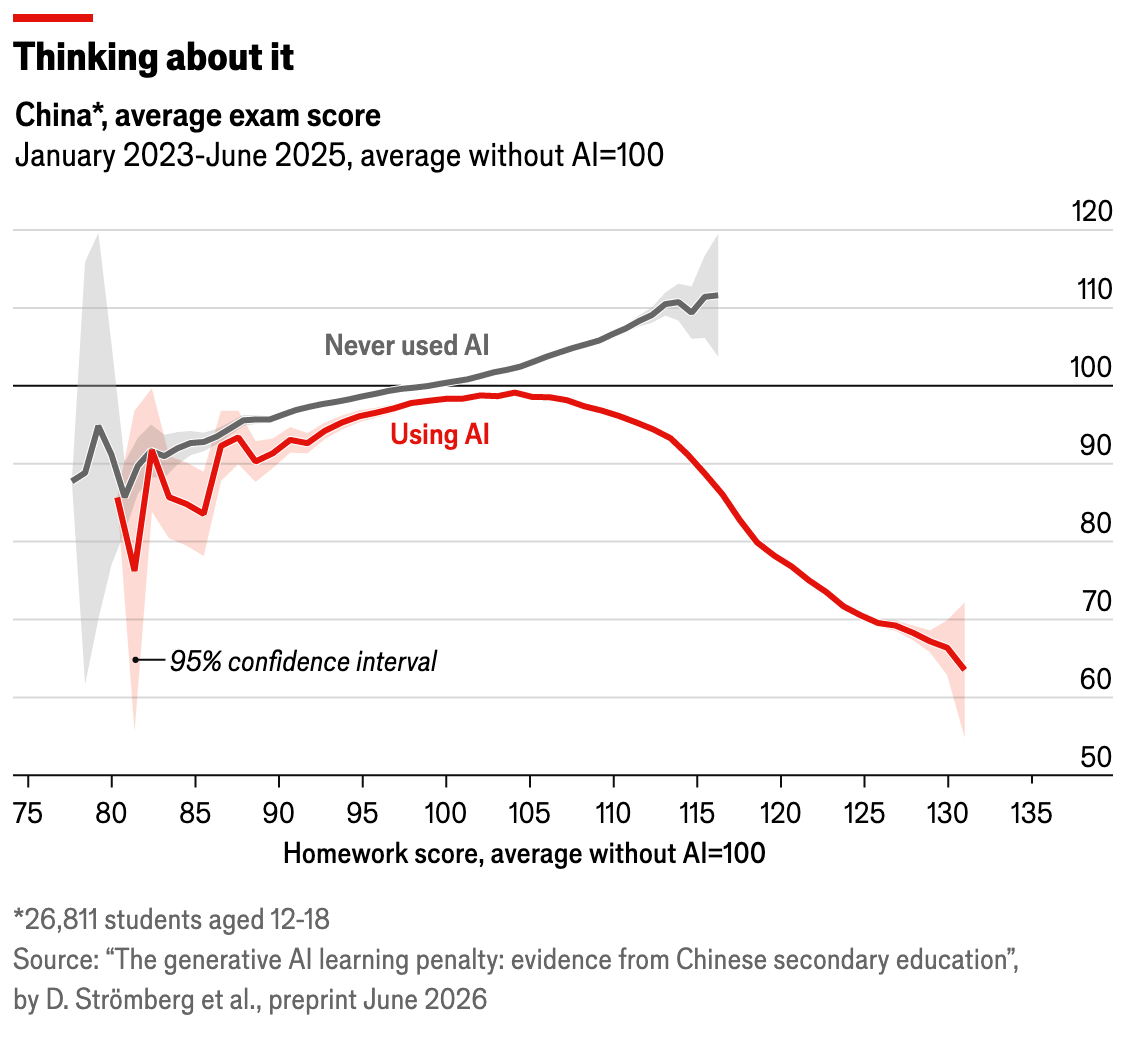
An interesting and (to this non-statistician) reasonable-looking paper on the effects of generative AI on exam scores (as a proxy for learning). As The Economist pithily puts it:

Homework scores once predicted exam performance; now those who score highest are, perversely, more likely to do worse in exams.

The paper’s own abstract reports:

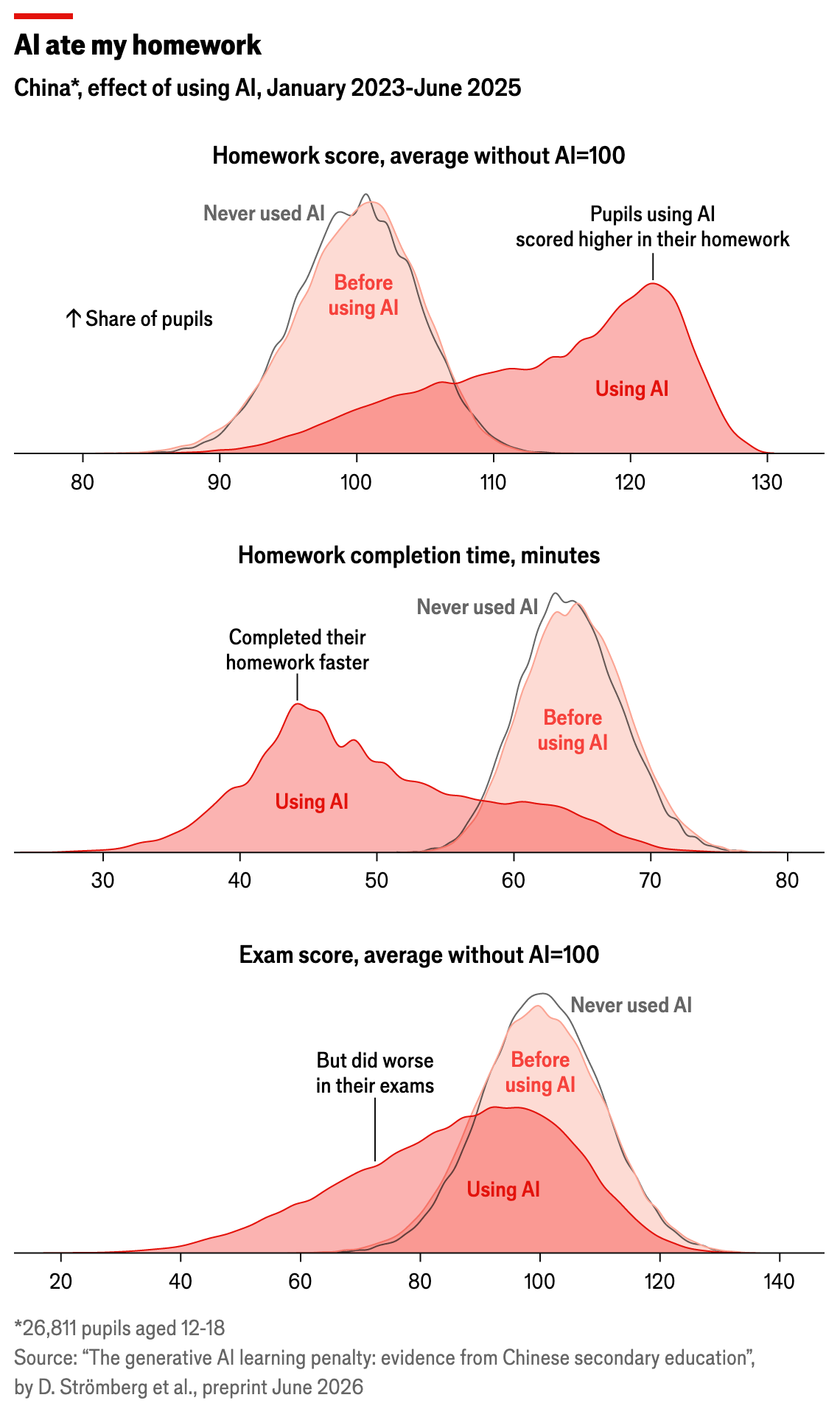
AI adoption raises homework scores by 18% and reduces completion time by 30%, but lowers monthly exam scores by 20% within six months. High-stakes entrance-exam scores fall by 18 and 24%, with the full penalty emerging only after about two years.

But all is not lost:

Those who used AI but spent as long on assignments as non-users paid little penalty.

Perhaps the crucial ingredient for exam success is simply putting in the effort to become familiar with the material.

These figures from The Economist’s article reproduce figures A11 and A5 from the paper, respectively, and capture the core results well:

Exam scores vs Homework scores

Effect of using AI

Links added 11 August 2026

The only reason you’ll ever need not to write with AI.

Colin Carlson (10 August 2026)
🔗 https://www.carlsonlab.bio/thoughts/the-only-reason-youll-ever-need-not-to-write-with-ai
#bcs #llm #writing #nuance #ethics

Using generative AI inherently exposes you to the risk of career-ending accusations of plagiarism. […] This is true for three basic reasons:

  1. Plagiarism is subjective.
  2. Plagiarism is a continuum.
  3. Not all plagiarism accusations are made in good faith.

Links added 31 July 2026

You have been misled about lightbulbs.

Maurycy Z. (30 July 2026)
🔗 https://maurycyz.com/misc/tungsten/
#nuance #bcs

There’s a story that goes something like this: “In 1925, lightbulb manufactures secretly colluded to standardized lifespans at 1,000 hours. They would test each other’s products to ensure compliance.”

The linked post digs a little deeper into this actually-true story, looking at bulb lifetime in context of physical constraints and cost-of-operation vs purchase price. Nuance!

Links added 10 July 2026

Against Vibes: When is a Generative Model Useful?.

William J. Bowman (5 March 2026)
🔗 https://www.williamjbowman.com/blog/2026/03/05/against-vibes-when-is-a-generative-model-useful/
#llm #nuance #bcs

An insightful investigation of the question “When is a Generative Model Useful?” Bowman proposes a model of generative model utility:

I think the usefulness of a generative model is a function of three things:

  1. What is the cost of encoding a generative task in a prompt vs. directly producing the artifact? This is a function of the task, the model, and the user.
  2. What is the cost of verifying the generated artifact meets requirements vs. a directly produced artifact? This is mostly a function of the task and the user, but also the generative model.
  3. How much is the task dependent on the artifact vs. the process? This is a function of the task.

Don’t Delete – Just Don’t.

Udi Dahan (1 September 2009)
🔗 https://udidahan.com/2009/09/01/dont-delete-just-dont/
#nuance #databases #bcs1510 #bcs

Pragmatics of database design: the argument for soft-delete (marking records as deleted rather than actually removing them).

Let’s say our marketing department decides to delete an item from the catalog. Should all previous orders containing that item just disappear? And cascading farther, should all invoices for those orders be deleted as well? Going on, would we have to redo the company’s profit and loss statements?

Tony Finch (April 2025) points out an important exception to the idea of just using IsDeleted flags, however:

The main counterexample is data protection law. You have to be able to delete personal data. This article predates the GDPR so it has a reasonable excuse for not taking it into account.